
Dental Loupes
Dental Loupes
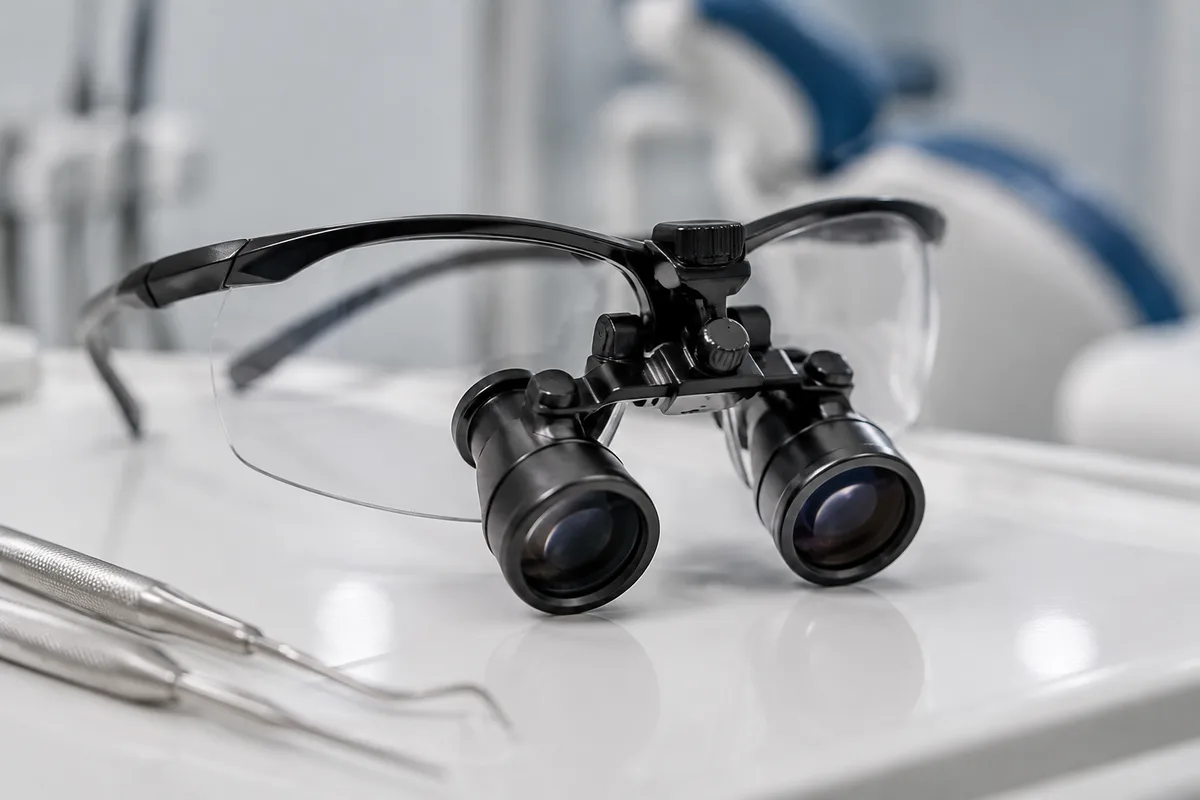
Dental loupes are the magnifying lenses many dentists wear during exams and procedures, and they are part of the everyday equipment Dr. Adam Salm relies on at Salm Dental. By enlarging the view of teeth, gum tissue, and root structures, loupes make it possible to see detail that is simply too small for the unaided eye — supporting more precise, controlled treatment from routine checkups to more involved procedures.
About Dental Loupes
Loupes are a pair of magnifying lenses, mounted on glasses or a headband, that a dentist wears throughout an exam or procedure. Unlike a microscope, which stays fixed in one position, loupes move with the dentist's head and hands, so the magnified view follows naturally as they work around the mouth.
Before magnification became standard, dentists worked largely at the scale of ordinary eyesight, which made it harder to spot fine cracks, early decay, or subtle changes in tissue. Loupes close that gap. Combined with a bright, focused headlight (often built into the same frame), they let the dentist see fine detail clearly even in the dim, tight space of the mouth.
How we use it at Salm Dental
Dr. Salm wears loupes as a routine part of exams and procedures, using the added magnification to work to a level of detail the naked eye cannot reach. This applies across many parts of a visit — from checking a tooth surface closely during an exam to guiding hand movements during more detailed procedures.
Loupes work well alongside the other tools in the office. During root canal therapy, for example, the added magnification pairs naturally with rotary endodontic instruments and apex locators, giving Dr. Salm a clearer view of canal openings while those tools measure and shape the canal itself. During gum treatments, magnification helps guide instruments like the soft-tissue laser or LANAP with more control. And when checking for early decay, loupes complement tools such as the caries detection laser and the intraoral camera — the camera lets you see what Dr. Salm sees on screen, while the loupes give him the magnified view in the moment.
What it means for you
Magnification generally supports more careful, controlled dental work. Because the dentist can see fine detail clearly, hand movements can be more precise — which is especially useful anywhere small margins matter, such as preparing a tooth for a filling or crown, or working near the edge of gum tissue.
For patients, this typically translates into a calmer, more predictable visit: less guesswork, steadier hands, and a dentist who can confirm visually what a procedure requires before proceeding. It doesn't change how a visit feels physically — loupes are simply glasses the dentist wears — so there's nothing extra for you to prepare for or notice, aside from a brighter light near your face.
What to expect during your visit
You won't need to do anything differently for a visit where loupes are used — there's no separate appointment or special preparation. Before the exam or procedure begins, Dr. Salm will put on his loupes, often with an attached headlight, just as he would put on gloves.
During the visit, you may notice the light is brighter and more focused than a typical exam light, and that Dr. Salm leans in closely to get a clear, magnified view of the area being examined or treated. This doesn't add time to routine parts of the visit; magnification is simply part of how the work is carried out from start to finish. Afterward, there's no recovery or aftercare tied to the loupes themselves — any follow-up instructions relate to the specific treatment performed, not to the magnification used during it.
Frequently asked questions
Is wearing loupes uncomfortable for the dentist or the patient?
No. Loupes are lightweight glasses worn by the dentist, not a device placed on or near the patient. Patients typically don't feel any difference during treatment other than a brighter, more focused light.
How long does a visit take when loupes are used?
Loupes don't add extra time to an appointment. They're worn throughout the exam or procedure as a normal part of how Dr. Salm works, rather than as a separate step.
Is magnification used for every type of visit?
Loupes can be used during routine exams as well as more detailed procedures, since the added detail is useful any time close inspection or fine hand control matters. Dr. Salm decides when magnification is helpful based on what the visit involves.
Is this safe for all patients, including children?
Yes. Loupes involve no radiation, sound, or sensation for the patient — they're simply a visual aid for the dentist — so there's no age or health restriction on their use.
If you'd like to know more about how magnification factors into your care, reach out to Salm Dental and we'll be glad to answer your questions.